
On any given day in 2021, an estimated 49.6 million people were living in modern slavery, including 27.6 million people in forced labour (1). Migrant workers are three times more likely to be in forced labour than non-migrant workers, and Asia and the Pacific carries the highest absolute number of people in forced labour of any region (2). These numbers have not improved on their own, and they will not improve through awareness, reporting and compliance alone.
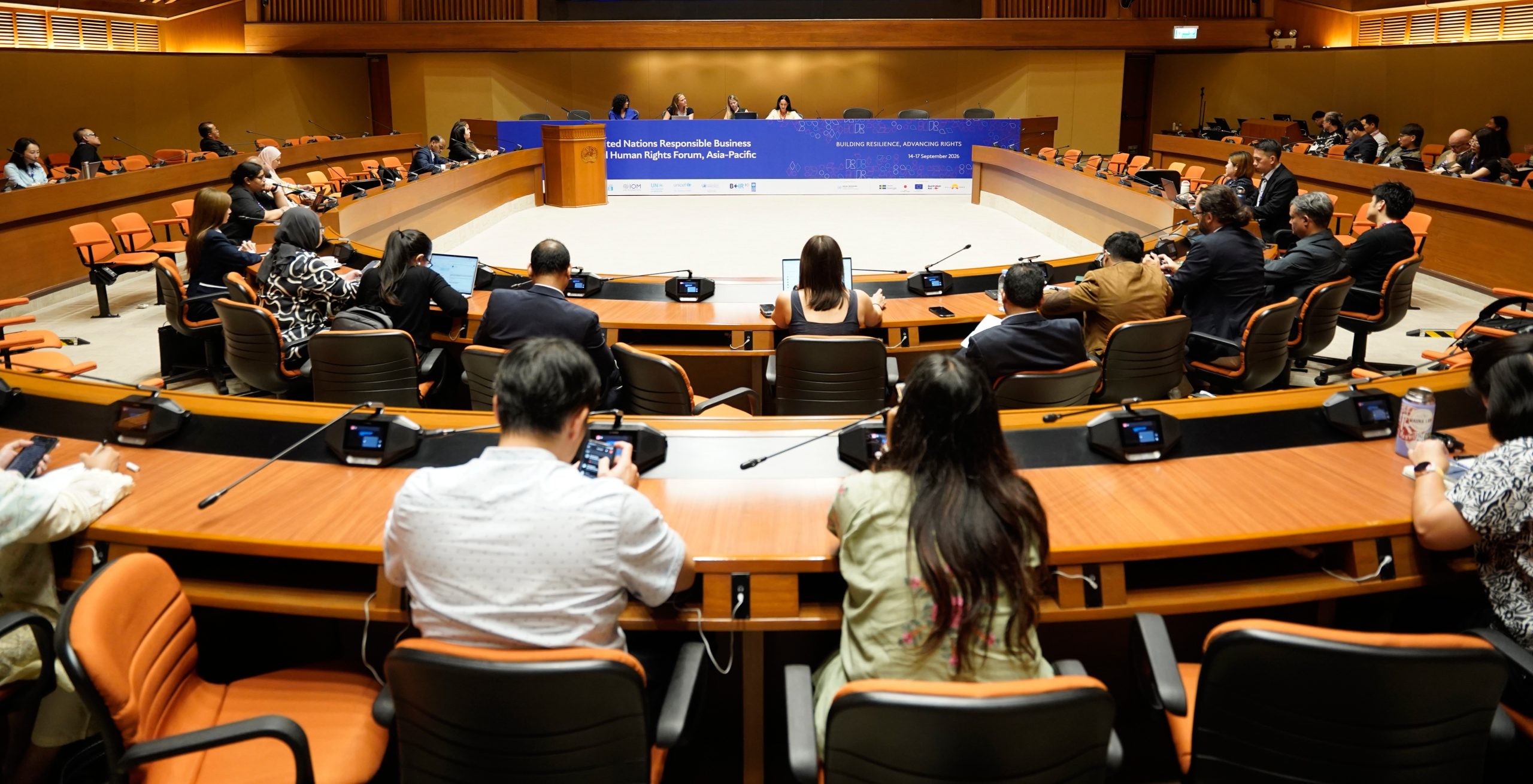
Last week we had the opportunity to speak about this at the 8th UN Responsible Business and Human Rights Forum, Asia-Pacific, held at the United Nations Conference Centre in Bangkok. Kate Skattang, our Technical Advisor, represented The Mekong Club on a panel alongside Ranjitha Kumar from the Thomson Reuters Foundation, Katie Yewdall from LRQA and Galina Panina-Sineau from Onwire Wellbeing Solutions.
The session tackled a question that sits at the heart of our work: how can companies and their partners combine collective action, human rights due diligence and skilled worker engagement to strengthen outcomes across Asia-Pacific supply chains, where forced labour and unethical recruitment risks are most prevalent? As the session framing set out, the gravest indicators of exploitation, including recruitment fees, contract substitution, document retention and debt bondage, typically arise at recruitment agencies, subcontracted worksites and worker dormitories, one to three tiers above the audited factory. No single company, method or discipline reaches those actors alone (3).
Disclosure alone does not create change
Transparency legislation raised the profile of modern slavery, but statements alone do not remove risk from a supply chain. Regulation is now shifting decisively towards mandatory due diligence, requiring organisations not simply to identify risk but to act on it, remediate harm and report on what they did.
At the same time the risk landscape is deepening. Climate change, the social costs of climate adaptation, economic fragmentation and geopolitical instability all intensify the vulnerability that makes exploitation possible. Compounding pressures fall hardest on the most marginalised and that resilience must address structural inequity rather than shift risk onto vulnerable populations.
Yet most organisations lack the in-house resources, skills or tools to meet the depth of due diligence now expected. That gap is where collaboration and consolidation of resources across sectors and geographies can help progress change.
What collaboration looks like in practice
Collaboration lets organisations align on what matters, pool resources and stop replicating the same work in parallel, and it can operate across a range of mechanisms.
Industry and peer collaborations, such as the Seafood Task Force, the Consumer Goods Forum and comparable initiatives in cotton, apparel, cocoa, tea and palm oil, bring competitors together around a shared sourcing risk, achieving scale and shared leverage.
Collaboration around certification, including Fairtrade, Rainforest Alliance and the RSPO, provides a common standard and third-party verification. The benefit is comparability, the limitation is that certification is a floor, not a substitute for a company’s own due diligence.
Facilitated collaboration through NGOs and multilateral bodies, such as the UN Global Compact, the Ethical Trading Initiative and The Mekong Club, offers neutral convening, technical guidance and safe space for candid discussion.
What makes collaboration work
- It is action-oriented. Attending conferences and webinars is collective learning. Collaboration begins when a group commits to a shared goal and follows through.
- It is deliberately convened. A dedicated organiser builds the calendar around real member issues and stops any single agenda dominating.
- It is focused. Successful groups tackle a small number of root-cause risks well, rather than a thousand issues poorly.
- It is measurable. Shared tools, joint investment and a repeatable baseline assessment allow progress to be reported to boards, investors, consumers and affected workers.
Getting past the barriers
- Collaboration should not create comparison. Organisations early in their journey hesitate to share for fear of appearing behind their peers. Convening around a shared activity and shared responsibility, rather than self-promotion, dissolves that quickly.
- Concerns around anti-competitive behaviour are gradually being addressed. In December 2025 the Australian Competition and Consumer Commission updated its sustainability collaboration guidance with modern slavery case studies developed with the Office of the Australian Anti-Slavery Commissioner, identifying low-risk activities such as notifying peers about a shared supplier showing modern slavery indicators, joint investigation of allegations, and development of joint voluntary supplier standards (4).
Where The Mekong Club fits
The Mekong Club began in 2011 as a small group of practitioners working through difficult questions together in joint working group discussions under Chatham House rules. Fifteen years on, our membership remains deliberately intimate so convening, coaching and one-to-one support stay meaningful. We identify what members need, including responsible recruitment, supplier due diligence, capacity building, standards development and data alignment, and build or source the tools to meet those needs.
If your organisation is ready to move from reporting to results, we would like to hear from you. Contact us at here.
References
- ILO, Walk Free and IOM, Global Estimates of Modern Slavery, 2022 [ilo.org]
- ILO, Data and research on forced labour [ilo.org]
- Session page, Collaborative and Worker-Centred HRDD for More Resilient Markets and Supply Chains [rbhrforum.com], [linkedin.com]
- Australian Anti-Slavery Commissioner, 5 December 2025 [antislaver…ner.gov.au]
Author: Kate Skattang, Technical Advisor at The Mekong Club
Photo by UNDP B+HR